What to ask a web design agency before you hire them
Most owners choose an agency on portfolio and price, then discover what actually matters after signing. Here are the questions to ask first, and the answers that should reassure or worry you.
Hiring a web design agency is an odd purchase. You are spending a meaningful sum on something you cannot inspect until it is finished, from people whose skills you are not well placed to judge, in a field full of terminology designed, it sometimes seems, to make you nod rather than ask. Most small business owners do it once every five years or so, which means they rarely get enough practice to become confident buyers.
The result is predictable. Owners choose on portfolio and price, the two things easiest to compare, and discover the things that actually decide whether a project goes well only after they have signed. Who owns the site. Who writes the content. What happens to their existing rankings. What the monthly bill will be in year two. Whether anybody will answer the phone when something breaks.
This article is the list of questions we would want a client to ask us, and the answers that should reassure you or worry you. Take it to your calls. A good agency will be glad you asked. One that becomes evasive has told you something important before you have paid anything.
Before you speak to anybody
The quality of the answers you receive depends heavily on the quality of the questions, and those depend on knowing what you want. An hour of preparation before your first call will make every proposal easier to compare.
Write down what the website is for
Not what it should look like. What it should do. Produce enquiries, take bookings, sell products, recruit staff, reassure existing clients, support a sales team. Most small business sites have one main job and two or three secondary ones. Rank them. An agency that knows the main job can design around it. One that does not will design around appearance.
Know your numbers
How many visitors does the current site receive, and how many enquiries or sales does it produce? If you do not know, find out before you commission a replacement, otherwise you will never be able to tell whether the new site is better. The same goes for your budget. Have a range in mind, even a rough one, so the conversation can focus on what is achievable. Our guides on what a web design agency should cost and how much to spend on marketing will help you set it.
List what must not break
Existing pages that bring in search traffic, email addresses on the domain, booking systems, payment integrations, the enquiry form your team relies on. Anything that currently works and would hurt if it stopped belongs on this list. It will shape several of the questions below.
Collect examples
Gather a handful of websites you admire and a handful you dislike, with a sentence on why for each. They need not be in your industry. This is far more useful to a designer than adjectives such as modern, clean or professional, which every client uses and each one means differently.
Questions about their work
Everybody shows a portfolio. The useful questions are about what sits behind it.
Can you show me sites you built for businesses like mine?
Not necessarily the same industry, but a similar size, budget and goal. An agency whose portfolio is full of large brand campaigns may not be set up for a five page site for a local firm, and vice versa. Ask to see live sites, not just images. Screenshots can be polished in ways a working website cannot.
What happened after those sites launched?
A beautiful site that produced no more enquiries than the one it replaced was not a success. A good agency can tell you, for at least some of its projects, what changed for the client afterwards: more enquiries, better quality leads, higher online sales, less time spent answering the same questions by phone. If every answer is about how the site looks, the agency may not be measuring what matters. Case studies on a work page should describe outcomes, not only visuals.
Can I speak to a client or two?
Ask for a reference from a project similar to yours, ideally one completed a year or more ago. A recent launch tells you the build went well. An older one tells you whether the site kept working and whether the agency stayed helpful once the invoice was paid. Ask the reference what went wrong and how it was handled. Every project has problems. What matters is how they were resolved.
Test the live sites yourself
Open two or three of their portfolio sites on your phone. Do they load quickly? Is the text readable? Can you find how to get in touch within a few seconds? Does anything look broken? Five minutes of this tells you more about the agency's standards than any sales call.
Questions about who will actually do the work
The person who sells you the project is often not the person who builds it. That is normal. What matters is knowing who is responsible and whether they have the skills your project needs.
Who will design and build my site?
Ask for names and roles. Is the work done in house, by freelancers the agency works with regularly, or outsourced to another company entirely? Any of these can work well. Outsourcing is not a problem in itself. Not being told about it is, because it affects communication, quality control and what happens if something needs fixing quickly.
Who will be my day to day contact?
You want a named person who understands the project, answers within an agreed time and can make decisions or get them made. Ask how quickly they typically reply, and how you should reach them. A project where every question passes through a sales account manager who then asks a developer tends to move slowly.
How many projects is that person running at once?
A fair question and a revealing one. A designer juggling fifteen projects will give yours less attention than one handling four. There is no correct number, but a vague answer is worth probing.
What happens if they leave?
People move on. Ask how the agency documents projects so that somebody else can pick yours up without starting again. Good agencies keep written specifications, shared design files and code in version control. If everything lives in one person's head, your project carries a risk you should know about.
Questions about process
A clear process protects both sides. It sets expectations about what happens when, what is needed from you and how decisions get made. Most project disputes are really process disputes.
What are the stages of the project, and what do I approve at each?
A good answer describes distinct phases, typically discovery, content and structure, design, build, testing and launch, with a clear point at the end of each where you review and approve before the next begins. Ask whether their process is written down. Approval points matter because they prevent expensive changes late in the project. Changing a layout at the design stage takes an afternoon. Changing it after the site is built can take days.
How long will it take, and what usually causes delays?
Ask for a realistic timeline with dates for each stage. Then ask what typically makes their projects run late. An honest agency will usually say the same thing: waiting for content and feedback from the client. That is not an accusation. It is useful information about what you need to prepare.
How many rounds of revisions are included?
Most agencies include a set number of revision rounds at each stage. That is reasonable, because unlimited revisions give nobody an incentive to decide. What you need to know is how many, what counts as a round, and what happens if you need more. Ask how they handle a situation where you simply do not like the first design, because it does happen.
How will we communicate during the project?
Regular calls, a shared project board, email updates, a staging site you can visit at any time? The answer matters less than having one. Projects go wrong quietly when nobody knows what is happening between milestones.
Questions about price and what is included
Two quotes with the same total can buy entirely different things. The purpose of these questions is to make proposals comparable.
Is this a fixed price, and what would change it?
A fixed price for a clearly defined scope puts the risk of estimating on the agency, which is usually good for you. But every fixed price has conditions. Ask exactly what would cause the price to rise: extra pages, extra features, late content, additional revisions. Get the answer in writing.
What is explicitly not included?
This question often tells you more than the list of inclusions. Copywriting, photography, stock images, content migration from the old site, search engine redirects, integrations, training, hosting, the first year of maintenance. Each of those can appear later as an extra cost if it was not in the proposal.
What will I pay each month and each year after launch?
Hosting, domain renewal, premium plugin or theme licences, maintenance, security, email accounts, any paid platform subscription. Some agencies quote a low build price and recover it through expensive ongoing fees. Others do the opposite. Ask for the total cost over three years, not just the build, and compare those figures across proposals.
How are payments structured?
A deposit followed by payments tied to milestones is normal and fair. Paying the full amount upfront is unusual and puts all the risk on you. Paying nothing until launch puts it all on the agency, which some will accept for very small projects. Make sure the final payment is due on launch or acceptance, so you retain some leverage until the work is complete. If an agency publishes its prices, you can compare its proposal against what it says publicly.
Questions about content
Content is the most common reason website projects run late and the most common reason finished sites underperform. It is also the area most often left vague in proposals.
Who is writing the words?
If you are, when do they need them, in what format, and will anybody edit them for the web? If the agency is, is copywriting included in the price, how many pages, and how will they learn enough about your business to write well? Good website copy depends on understanding your customers, which usually means an interview or workshop with you rather than guesswork.
What happens to the content on my current site?
Will it be moved across as it is, rewritten, or left behind? Moving content from an old site, known as migration, can be substantial work, particularly for sites with many pages, blog posts or products. It is frequently missing from quotes and then appears as an extra.
Where are the photographs coming from?
Stock photography is quick and cheap, and visitors recognise it instantly. Real photographs of your team, premises and work are almost always more convincing, particularly for a small business, where customers are choosing people as much as a company. Ask whether photography is included, can be arranged, or needs to be sourced by you, and when it needs to be ready.
Will the site be built around real content or placeholder text?
Designing with placeholder text is common and causes problems. A layout that looks elegant with two lines of dummy text may fall apart when your actual paragraph is five lines long. Agencies that ask for real content, or at least a realistic draft, before designing produce sites that work better when they launch.
Questions about platform and technology
You do not need to understand the technical details, but you do need to understand the consequences of the choices being made on your behalf.
What will the site be built on, and why?
WordPress, Shopify, Webflow, Squarespace, a custom build or something else. Each has strengths and each creates dependencies. A good agency explains why the platform suits your needs rather than simply using the one it always uses. For online shops, the choice between platforms has particular long term consequences, which we covered in Shopify or WooCommerce: choosing without the sales pitch.
Could I move to another developer later?
On widely used platforms with standard approaches, another competent developer can usually take over. On heavily customised builds, proprietary systems or platforms controlled by the agency, moving can be difficult or impossible without starting again. Ask directly, and be cautious of any system that only the agency can work on.
Will I be able to edit the site myself?
Which parts? Text, images, blog posts, products, prices, new pages? Ask for a demonstration of the editing interface before you commit, and ask whether training is included. Some sites are easy to update. Others require a developer for every change, which becomes expensive and slow.
How many plugins or third party tools will it rely on?
Every additional plugin or external service is another thing that can conflict, slow the site down, stop being supported or require a paid licence. A site built on a small number of well chosen components is easier and cheaper to maintain than one assembled from dozens.
Questions about ownership
This is the section most small business owners skip and most regret skipping. Ask these questions before signing, and make sure the answers appear in the contract.
Who owns the domain name?
Your domain should be registered in your name, or your company's name, with login details you hold. If an agency registers it on your behalf in its own account, you may find it difficult to move later. Your domain is where your email lives and where your reputation points. It should never belong to a supplier.
Who owns the website, the design and the code?
Once you have paid in full, you should own the site and have the right to use, change and move it. Some agencies retain ownership and licence the site to you, or retain rights to custom components. That may be acceptable if clearly explained, but you need to know.
Who holds the hosting account?
If the agency hosts your site, what happens if you leave? Will they provide a full copy of the site and its database? How quickly, and at what cost? If you host it yourself, who manages the account?
Whose name is on the analytics and business accounts?
Analytics, search console, Google Business Profile, advertising accounts, email platforms. All of these should be owned by you, with the agency given access as a user. Years of data sitting in an account the agency controls is data you can lose.
A good answer to every question in this section is short and clear: you own it, and we have access. Anything more complicated deserves a careful read.
Questions about search and existing rankings
If your current website brings in any search traffic, a new site can protect it or destroy it. Redesigns that wipe out years of rankings overnight are extremely common and almost entirely avoidable.
How will you protect the search traffic my current site receives?
A good answer mentions auditing which pages currently bring in visitors, keeping or redirecting their addresses, preserving the content that ranks, carrying over page titles and descriptions, and checking the new site in search console after launch. If the answer is vague, or treats search as something that can be dealt with after launch, be worried. We set out the full process in how to redesign a website without losing your rankings.
Will every old page address be redirected?
When page addresses change, the old ones must be permanently redirected to their new equivalents. Otherwise visitors and search engines arriving at old links find error pages, and the rankings those pages earned disappear. Ask who creates the redirect list and when it is tested.
What search work is included in the build?
Technical basics such as page titles, descriptions, headings, image text, sitemaps, structured data and a site that loads quickly should be part of any competent build. Ongoing search work, such as content, local search and link building, is usually separate. Ask what the build includes and what would cost extra, because many proposals use the word optimised without saying what it means.
Questions about speed, accessibility and mobile
These are the qualities visitors notice without being able to name, and search engines measure directly. They are also the areas where cheap builds most often cut corners.
How fast will the site be, and how will you measure it?
A confident agency will talk about loading speed measured on real mobile devices, not only a score on a fast office connection. Ask whether they have targets for Google's Core Web Vitals and whether their recent sites meet them. Our article on the Core Web Vitals work that actually moves rankings explains what good looks like.
How do you design for mobile?
Most small business visitors arrive on phones. Ask whether the agency designs the mobile version first or adapts the desktop design afterwards, and ask to see mobile designs at the approval stage, not only desktop ones. Check things that matter on a phone: tappable phone numbers, readable text, easy forms and buttons large enough to hit.
Will the site be accessible?
Accessibility means people with visual, hearing, motor or cognitive impairments can use your site. It improves the experience for everybody, supports search visibility and in many cases is a legal expectation. Ask which standard the agency works to and how they test against it. A good agency will mention colour contrast, keyboard navigation, text alternatives for images and form labels without being prompted.
Which browsers and devices will you test on?
A site that works perfectly on the designer's laptop can break on an older phone or a different browser. Ask what testing happens before launch and whether it includes real devices.
Questions about security and data
Small business websites are attacked constantly, not because anybody has singled them out but because automated tools scan every site on the internet for known weaknesses. A site holding enquiry details, customer accounts or payment information also carries legal responsibilities. These questions are easy to overlook and expensive to get wrong.
How will the site be kept secure?
A good answer covers a secure connection on every page, strong passwords and two step login for anybody who can edit the site, limited administrator accounts, software kept up to date, protection against automated login attempts and a firewall or equivalent at the hosting level. Ask who is responsible for each of these after launch, because security is not something that is finished on launch day.
How often is the site backed up, and where?
Backups should be automatic, frequent, stored somewhere separate from the website itself and tested occasionally to prove they can actually be restored. Ask how far back you could go if the site were damaged, and how long a restore would take. A backup stored on the same server as the site it protects is of little use if that server fails.
How will you handle the personal data the site collects?
Enquiry forms, newsletter signups, bookings and accounts all collect personal information. Ask where submissions are stored, who can access them, how long they are kept and whether the forms only ask for what is genuinely needed. A good agency will also raise your privacy policy and cookie consent without prompting, and will explain which tracking tools need consent before they run. You remain responsible for the data, so you need to understand where it goes.
Will you take payments on the site, and how?
If the site sells products or takes deposits, ask which payment provider will be used and whether card details ever pass through or are stored on your website. For most small businesses the answer should be no: payments should be handled entirely by an established provider, which removes most of the security burden from your site.
What happens if the site is hacked?
Ask whether the agency has dealt with a compromised site before, what it would do, how quickly, and whether the cleanup is covered by a maintenance plan or charged separately. An agency that answers calmly and specifically has probably done it. One that insists it could never happen has probably not.
Questions about launch and after launch
Launch is not the end of a website project. It is the start of the period in which the site either earns its cost or quietly decays.
What happens on launch day?
Ask for a launch checklist. It should include testing every form, checking redirects, confirming analytics and tracking are recording, verifying the site in search console, checking email still works and making a full backup. Ask what time they launch and who is available if something goes wrong. Launching late on a Friday afternoon is a well known recipe for a difficult weekend.
Is there a period after launch for fixes?
Most good agencies include a period, often thirty days, during which problems with the build are fixed at no cost. Ask how long it lasts and what it covers. Bugs should be covered. New requests usually are not.
What does ongoing maintenance involve, and what does it cost?
Websites need updating. Software, plugins and security measures change constantly, and an unmaintained site becomes slower, less secure and more likely to break. Ask what a maintenance plan covers: updates, backups, security monitoring, uptime checks, small content changes and response times for problems. Ask what happens if you decline maintenance, and whether you can cancel at short notice.
How quickly will you respond if the site goes down?
Ask for a specific answer, and ask whether it is written into the maintenance agreement. For a business that takes orders or bookings online, hours matter.
Questions about results and measurement
A website is a business tool. The agency should be interested in whether it works as one.
How will we know whether the new site is better than the old one?
A good answer involves measuring enquiries, sales or bookings before and after, not just visitor numbers. It involves setting up tracking for forms, phone calls and purchases before launch, so there is a reliable baseline. If the agency has no view on how success will be measured, it may not be thinking about it.
What will be tracked from day one?
Form submissions, clicks on phone numbers and email addresses, purchases, bookings and key actions such as brochure downloads. Ask who sets this up and how it will be tested. Tracking that is added months after launch loses the most valuable comparison period.
Will you look at the results with me after launch?
A review a month or two after launch, looking at how visitors are using the site and where they drop out, is one of the most valuable services an agency can offer. Small adjustments based on real behaviour often improve results significantly. Ask whether this is included or available.
Questions about contracts and what happens if it goes wrong
Nobody enjoys this part of the conversation. It is still worth having, because the time to agree how problems are handled is before there are any.
Can I see the contract before committing?
Read it properly. Look for scope, timeline, payment terms, what counts as acceptance of the work, ownership, revision limits, what happens if either side wants to end the project early and how disputes are resolved. If something in the conversation was promised but is missing from the contract, ask for it to be added.
What happens if the project is late?
If the delay is caused by the agency, what do they do about it? If it is caused by you, for example by late content, how does that affect the timeline and the price? Clear terms prevent arguments.
What happens if I am not happy with the result?
Approval stages should make this unlikely, because you will have agreed the design before it is built. But ask anyway. A good agency will describe how it resolves disagreements and what happens if the relationship genuinely breaks down, including what you receive for what you have paid.
What do I receive if the project ends early?
Circumstances change on both sides. A business may be sold, an agency may close, or the working relationship may simply fail. Ask what you would receive for the money already paid if the project stopped partway through: design files, written content, code completed so far, research and any accounts set up for you. A fair contract makes sure you are never left with nothing to show for completed stages, and makes clear what you owe for work already done.
Is there a minimum term for ongoing services?
For maintenance, hosting or marketing services, long minimum terms are a warning sign. Monthly agreements with reasonable notice periods suggest an agency confident that you will want to stay.
Red flags worth walking away from
Some answers, or patterns of behaviour, should make you hesitate however good the portfolio looks.
- A price given before any questions are asked. An agency that quotes without understanding your business is quoting for a template, whatever it calls it.
- Guaranteed first page rankings. Nobody controls search results. Guarantees usually mean obscure search terms nobody uses, or tactics that risk penalties.
- Reluctance to discuss ownership. Any hesitation about your owning the domain, the site or the accounts deserves a direct follow up.
- No questions about your customers. An agency that asks about colours and fonts but not about who buys from you and why is designing for itself.
- Pressure to decide quickly. Discounts that expire tomorrow suit sales targets, not good decisions.
- No written process or contract. Informality feels friendly until something goes wrong.
- Portfolio sites that are slow or broken. If their showcase work has problems, yours probably will too.
- Everything included, for very little. A price far below other quotes for the same scope means something has been left out, compressed or outsourced cheaply.
- No mention of what happens after launch. A site with no plan for its first year is a liability with a launch date.
How to compare proposals fairly
Once the proposals arrive, resist the temptation to compare the totals first. Line them up against each other on the things that matter.
- Scope. Number of page templates, features, integrations, content migration, copywriting and photography. Make sure you are comparing the same job.
- Three year cost. Build plus hosting, licences, maintenance and any other recurring fees over three years.
- Ownership. Who owns the domain, site, code and accounts, according to the contract.
- Search protection. Whether redirects, migration of ranking content and post launch checks are included.
- Timeline. Realistic dates for each stage, and what the agency needs from you to meet them.
- People. Who will do the work and who you will speak to.
- Evidence. Outcomes from similar projects and what references said.
- Understanding. Which agency best understood what your website is for. This is the hardest to score and often the most important.
The cheapest proposal is sometimes the right one, particularly for a simple site. The most expensive is sometimes the right one too. The goal is to choose the proposal that gives the best result for your business over the life of the site, which is rarely obvious from the first page of a quote.
What a good agency will ask you
A useful way to judge an agency is to notice the questions it asks. The right agency will be trying to understand your business as carefully as you are trying to understand theirs.
- Who your customers are, what they need and how they currently find you.
- What the website should achieve, and how you will know if it has.
- How many enquiries or sales the current site produces, and what happens to them.
- Which pages currently bring in search traffic.
- Who will provide content and photography, and when.
- Which systems the site must work with.
- Who will make decisions and approve work on your side.
- What budget and timescale you have in mind.
- What would make this project a success in a year.
If an agency asks few of these questions, its proposal is based on assumptions. If it asks most of them, it is building a site for your business rather than a site it could build for anybody.
A checklist to take to your calls
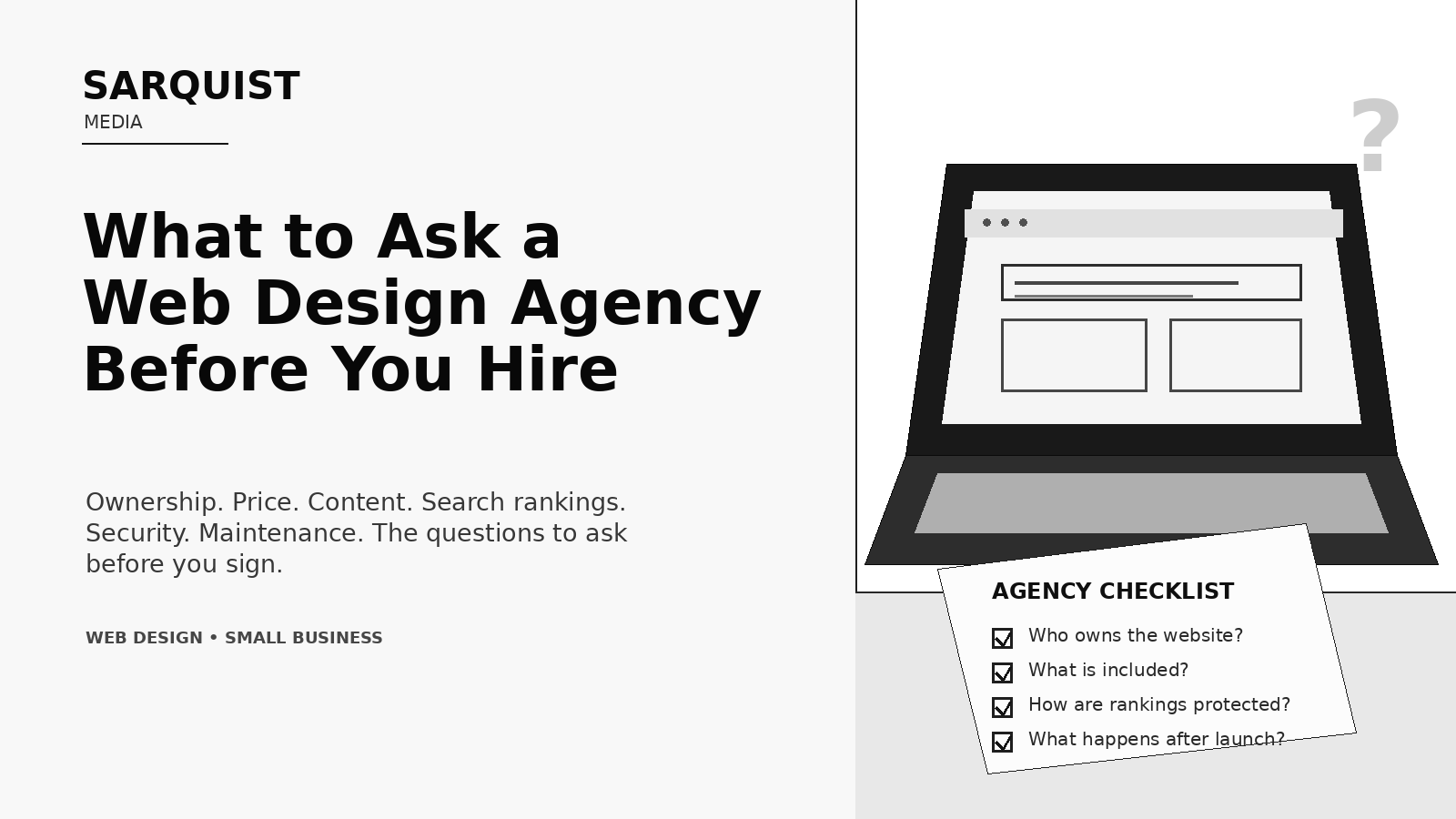
Print this, or keep it open during each conversation, and note the answers. Comparing agencies becomes much easier when you have asked each of them the same things.
- Can you show me live sites for businesses like mine, and what happened after they launched?
- Can I speak to a client from a project completed a year or more ago?
- Who will design, build and manage my project, and are any parts outsourced?
- What are the stages, what do I approve at each, and how many revisions are included?
- Is the price fixed, what would change it, and what is not included?
- What will I pay each month and year after launch, over three years in total?
- Who writes the content, who provides the photography, and what happens to my existing content?
- What platform will you use, why, and could another developer take over later?
- Will I own the domain, the site, the code and all accounts?
- How will you protect my current search traffic, and will every old address be redirected?
- How fast will the site be on mobile, and how will you make it accessible?
- What happens on launch day, what is covered afterwards, and how quickly will you respond to problems?
- How will we measure whether the new site is better than the old one?
- Can I read the contract, and what happens if the project runs late or goes wrong?
If you would like to put these questions to us, we are happy to answer every one of them in writing before you commit to anything. Our process and prices are published for exactly that reason.
Want this handled for you?
We build and run the sites we write about. Tell us the target and we will scope it.
Start a project