Google Ads or SEO: which should a small business do first?
One agency says SEO builds long term value. Another says ads will fill the diary by Friday. Here is how to work out which one fits your business, and how to spend a small budget on it without waste.
You have a budget for marketing and it is not large. One agency tells you search engine optimisation is the only thing that builds long term value. Another tells you Google Ads will have the phone ringing by Friday. Both are describing something true, both are selling the thing they are describing, and neither has told you how to choose.
This article is the conversation we have with small businesses before they commit to either. It will not tell you one channel is better, because it is not. It will tell you which one fits your situation, how to spend a modest budget on it without waste, and how to use the first channel to make the second one cheaper when you are ready for it.
The short answer
If you need enquiries within the next three months, start with Google Ads. If you can wait six to twelve months and want the cost per enquiry to fall over time, start with SEO. If you are unsure whether anybody searches for what you sell, start with a small, tightly controlled Google Ads test, because it answers that question in weeks rather than a year.
That is the answer most small businesses need. The rest of this article is the reasoning behind it, and the details that decide which side of that line you actually sit on.
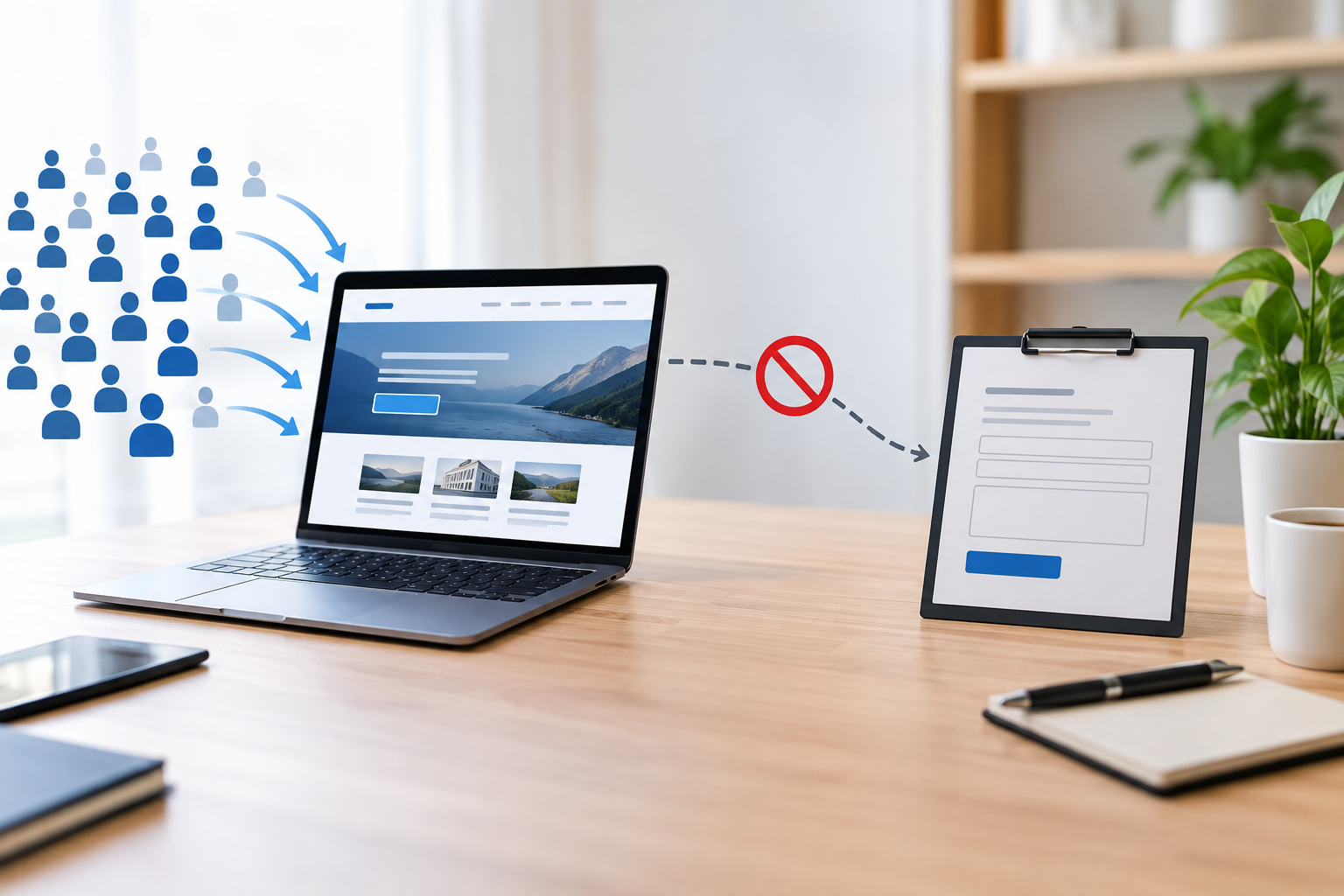
One condition applies to both routes. If your website does not convert the visitors it already has, neither channel will save you. Paid traffic will cost money and produce nothing, and organic traffic will arrive slowly and produce nothing. Check that first. We covered how in why your website gets traffic but no enquiries, and it is worth an afternoon before you spend anything on either channel.
What each channel actually buys you
The two are often discussed as though they were competing brands of the same product. They are not. They buy structurally different things, and most of the confusion comes from treating them as interchangeable.
Google Ads buys you rented position
You pay to appear at the top of the results for searches you choose, in places you choose, at times you choose. You pay each time somebody clicks. When you stop paying, you disappear from those positions immediately and completely. Nothing accumulates.
What you get in exchange is speed, control and data. An advert can be live within a day. You decide exactly which searches trigger it, which areas see it and what it says. Every click, every search term and every enquiry is recorded, which makes paid search one of the fastest ways available to learn what your market actually wants.
SEO buys you an owned asset
Search engine optimisation is the work of making your own pages deserve to rank without payment. That means pages that answer real questions, a site that loads quickly and is easy for search engines to understand, a Google Business Profile that is complete and reviewed, and a reputation elsewhere on the web that points back to you.
When it works, it keeps working after you stop spending, at least for a while. Each well ranked page brings visitors every month with no charge per click. The cost is front loaded and the return is back loaded, which is the opposite shape to advertising.
What you give up is speed and certainty. You cannot choose to rank. You can only make yourself the most deserving candidate and wait for the search engine to agree.
The simplest way to hold the difference
Advertising is renting. SEO is buying with a mortgage. Renting gets you through the door this month and leaves you with nothing when you stop paying. Buying costs more before you move in and leaves you with something at the end. Neither is the wrong choice in general. Each is the wrong choice for somebody in particular circumstances.
How long each one takes to work
This is usually the deciding factor for a small business, so it is worth being precise about it.
Google Ads: days to weeks
A properly built campaign can produce its first enquiries within days of launch. That does not mean it is working well within days. The first two to four weeks are a learning period in which you discover which search terms bring buyers, which bring browsers, which areas perform and what an enquiry really costs. Expect the cost per enquiry in month one to be noticeably higher than in month three, provided somebody is actively improving the account in between.
SEO: months, not weeks
For a small business in a moderately competitive local market, meaningful movement from SEO work usually takes somewhere between three and six months to appear and six to twelve months to become reliable. For a new website with no history, or a genuinely competitive national market, it takes longer.
There are faster wins inside that. Fixing a broken Google Business Profile, correcting technical problems that were preventing pages from being indexed, or publishing a service page for something you were not ranking for at all can move results within weeks. But the compounding effect that makes SEO worth doing is a slow process, and anybody promising first page rankings in thirty days is either targeting searches nobody makes or telling you something that is not true.
What this means for your decision
Ask how long your business can wait for the channel to start paying for itself. If the honest answer is not long, because cash flow is tight or you have a new van to fill with work, SEO on its own is the wrong first step however good the long term argument is. You need something that produces enquiries while the slow work matures.
What each one really costs a small business
Figures below are written without a currency because we work across several, and because the ranges vary more by industry than by country. Treat them as orders of magnitude.
The real cost of Google Ads
There are two costs, and small businesses routinely budget for only one. The first is media spend, the money that goes to Google for clicks. The second is management, whether that is an agency fee or your own time.
Click prices depend entirely on your market. Some local service searches cost well under one per click. Legal, financial, emergency trade and certain medical searches can cost many tens per click. Before you commit to a budget, find out roughly what clicks cost in your specific market, because it determines whether a given budget is enough to learn anything.
A useful rule: your monthly media budget needs to buy enough clicks to produce enough enquiries to make decisions from. If clicks in your market cost ten and one visitor in twenty enquires, each enquiry costs roughly two hundred. A monthly budget of three hundred buys you one or two enquiries, which is not enough data to optimise anything. You would either need a larger budget, a narrower target, or a different channel.
The real cost of SEO
SEO is mostly paid for in time, whether yours or somebody else's. Writing service pages, fixing technical issues, building local citations, asking customers for reviews and earning links from other sites all take hours. An agency retainer converts those hours into a monthly fee.
The cost you will not see on an invoice is the cost of waiting. If SEO takes eight months to produce enquiries, you are paying for eight months before any return arrives. For a business with healthy cash flow that is an investment. For a business that needed work next month it is a risk.
Comparing them fairly
The right comparison is not the monthly fee. It is the cost per enquiry over a realistic period. Google Ads tends to produce a cost per enquiry that is fairly stable and falls modestly as the account improves. SEO produces a very high cost per enquiry in the early months, because you are paying and receiving little, then a falling one as rankings build, often ending far below what advertising would cost for the same traffic.
Over twelve months, advertising is usually cheaper. Over thirty six months, well executed SEO usually wins. Where your business sits on that timeline is the real question.
The five questions that decide it
Work through these honestly. Most small businesses find the answer becomes obvious by the third one.
Do people search for what you sell?
Both channels depend on search demand. If nobody types your service into a search box, neither will help much, and you need a different approach entirely. Some offers are discovered rather than searched for: a new kind of product, a niche business to business service, anything people do not yet know exists. For those, social advertising, partnerships and direct outreach usually outperform search.
If you are not sure, a small paid search test is the fastest way to find out. Within a few weeks you will see real search volume and real search terms, which no keyword tool can fully replicate.
How soon do you need enquiries?
Covered above. If the answer is this quarter, advertising leads.
What is a customer worth to you?
Work out the value of a typical new customer over the first year, not just the first job. A bathroom fitter whose average job is worth several thousand can afford to pay far more per enquiry than a dog groomer whose average visit is worth forty, even if the groomer's customers return monthly.
High customer value makes advertising easier to justify, because even an expensive click can pay for itself. Low customer value with high search competition makes advertising difficult and pushes the answer toward SEO, local search and repeat business.
How competitive is your market in search?
Search for your main service in your area. Look at who ranks. If the first page is full of national directories, large chains and websites that have clearly been worked on for years, organic rankings will take longer and cost more. If the first page contains outdated sites, thin pages and competitors who do not seem to have tried, the opportunity for SEO is considerable and relatively quick.
Look at the adverts too. If nobody is advertising, clicks will be cheap. If six competitors are advertising, clicks will be expensive, but that also tells you the searches are profitable enough for others to pay for.
Who is going to do the work?
A Google Ads account left alone slowly wastes money. It needs weekly attention at minimum: checking search terms, adding negative keywords, adjusting bids, testing adverts. SEO needs steady monthly effort. Be honest about whether you will do this yourself, whether you have somebody who can, or whether you will pay for it. A channel run badly is often worse than a channel not run at all.
When Google Ads should come first
Advertising is usually the right first move in the following situations.
- You need work quickly. A new business, a new service, a quiet season, a team with spare capacity. Advertising is the only search channel that responds on that timescale.
- Your customers search with urgency. Emergency plumbers, locksmiths, boiler repairs, same day couriers. The searcher wants somebody now and clicks the first credible result, which is frequently an advert.
- A customer is worth a lot. When one new client covers months of spend, the maths of paid search works even at high click prices.
- Your organic competition is entrenched. If the first page has been held by the same established players for years, advertising gets you into the conversation while the slow work proceeds.
- You are launching something and need data. A new product, a new area, a new price point. Paid search tells you within weeks whether demand exists and what people call it.
- Your website is new. A brand new domain with no history ranks slowly. Advertising gives it traffic from the first day.
If several of those describe you, start with advertising and treat SEO as the second step rather than an alternative. Our approach to Google Ads management is built around exactly this sequence.
When SEO should come first
Organic search is usually the better first investment in these situations.
- You can wait. Existing work keeps the business running and you want to build something that lowers acquisition costs over years rather than weeks.
- Clicks in your market are expensive and customers are not worth much. The advertising maths simply does not work, however well the account is run.
- Your local competition is weak online. Outdated websites, incomplete business profiles and few reviews among your competitors are an open door.
- Your customers research before they buy. Considered purchases involve several searches over days or weeks. Owning the informative answers at each stage builds trust that an advert cannot.
- Your site has fundamental problems. If pages are not indexed, the site is slow or service pages do not exist, fixing that is foundation work that also makes advertising cheaper later.
- Your budget is too small to learn from advertising. If the monthly amount would buy a handful of clicks, it is better spent on pages and profiles that keep working.
For most local service businesses in this position, the first SEO priority is not blogging. It is a complete Google Business Profile, a proper page for each service, accurate information across directories and a steady flow of reviews. Content comes after the foundations.
The businesses that should do neither yet
Sometimes the right answer is to spend on neither channel for now. That is an unpopular thing for an agency to say, which is exactly why it is worth saying.
If your website cannot convert visitors, fix that first. Sending paid traffic to a page that does not produce enquiries is the fastest way we know to conclude, wrongly, that Google Ads does not work for your industry.
If your tracking is broken, fix that too. You cannot run advertising well without knowing which clicks produced enquiries, and you cannot judge SEO without knowing where enquiries came from. Setting up measurement properly is dull, cheap and essential. The most common way it goes wrong is described in the conversion tracking mistake in most ad accounts.
If you cannot handle more work, wait. Advertising that produces enquiries you cannot respond to damages your reputation and wastes money. Sort capacity first.
And if your offer is unclear, clarify it. If you cannot explain in one sentence what you do, who for and why somebody should choose you, neither an advert nor a ranking page will explain it for you.
How to run Google Ads on a small budget without wasting it
Most small business advertising waste comes from a handful of settings and habits. Avoiding them is worth more than any clever strategy.
Narrow everything
A small budget spread thinly across many services, a wide area and all hours of the day learns nothing. Pick your most profitable service. Pick the area you most want work in. Run adverts during the hours you can answer the phone. Concentrate the budget where each click has the best chance of becoming a customer, prove it works, then expand.
Control the searches you appear for
Broad keyword settings allow Google to show your adverts for searches it considers related. On a large budget with good conversion data, that can work. On a small budget it frequently means paying for searches like free, jobs, training, how to, and competitor names you had no intention of targeting.
Use tighter matching to begin with. Review the search terms report every week and add every irrelevant phrase as a negative keyword. In the first month this single habit usually saves more money than any other.
Check the defaults
New campaigns often include settings that suit Google more than they suit a small business. Display network placements bundled into a search campaign. Location settings that include people interested in your area rather than people in it. Automatically applied recommendations. Check each one deliberately rather than accepting the default.
Send clicks to a page built for them
An advert for emergency boiler repair should land on a page about emergency boiler repair, not your homepage. The page should repeat the promise from the advert, show a phone number that can be tapped on mobile, and make the next step obvious. A dedicated landing page commonly improves the enquiry rate from paid traffic more than any change inside the ad account.
Measure enquiries, not clicks
Clicks and impressions are not results. Track form submissions, phone calls from adverts, and calls from your website. Without that, the account cannot optimise toward what matters, and neither can you.
Give it a fair test
Decide in advance how long you will run the test and what result would count as success. Something like: three months, with a target cost per enquiry based on what a customer is worth. Ending after two weeks because the first enquiries were expensive tells you nothing. Continuing for a year because you hope it will improve is the other common mistake.
How to start SEO when you cannot afford an agency retainer
A great deal of useful SEO work for a small local business can be done by the owner, provided it is done in the right order and consistently.
Start with your Google Business Profile
For local searches, the map results often appear above the organic listings. Choose the most accurate primary category, fill every relevant field, list your services, add genuine photographs regularly, keep your hours accurate and reply to every review. Then ask every satisfied customer to leave one. Most small businesses never ask, and it is the single most effective local search habit available.
Build one page per service
If you offer six services and have one page listing them all, search engines have one page to rank for six different searches, and it will rank weakly for all of them. Give each important service its own page with its own heading, a clear description of what is included, the areas you cover, typical prices or ranges, examples of the work and a way to get in touch.
Write them in the words your customers use. Your enquiry emails and phone calls are the best keyword research you will ever have.
Fix the technical basics
Make sure your pages can be indexed, each has a unique title and description, the site works well on a phone and it loads quickly. Google Search Console is free and tells you most of what is wrong. Speed deserves particular attention because it affects both rankings and whether visitors stay, as we explain in the Core Web Vitals work that actually moves rankings.
Be consistent everywhere
Your business name, address and phone number should appear identically on your website, your business profile and every directory where you are listed. Inconsistency confuses search engines and customers alike.
Then write for the questions customers ask
Once the foundations are in place, write articles that answer the questions you hear repeatedly. How much does this cost. How long does it take. Do I need planning permission. What is the difference between this and that. Answer directly and specifically, with details only somebody who does the work would know. Content like this is increasingly what gets cited in AI generated search answers too, which we covered in writing pages that rank in Google and get cited by AI search.
Link each article to the relevant service page. An article that helps somebody and then offers no next step has done half its job.
Using ads to decide what SEO should target
This is the part most small businesses miss, and it is where the two channels stop being rivals.
A Google Ads account records every search term that triggered an advert, and which of those terms produced enquiries. After a few months, you know with real data which phrases your buyers use, which areas produce customers and which services are most profitable to advertise.
That is exactly the information SEO needs and usually has to guess at. Keyword tools estimate search volume. They do not know which searches turn into paying customers for your business. Your advertising data does.
So use it. Take the search terms that produce enquiries most cheaply and make sure you have an excellent organic page for each. Take the terms that are most expensive per click and prioritise ranking for those, because every organic visitor for an expensive term saves the most money. Take the terms that never convert and do not waste SEO effort on them.
Handled this way, even a modest advertising budget in the early months is not only buying enquiries. It is buying the research that makes your SEO spend more accurate.
Why the two work better together than apart
Once a business can afford both, running them together usually produces more than the sum of each run separately.
- More of the page is yours. Appearing in the adverts, the map results and the organic listings for the same search makes you look like the obvious choice and leaves less room for competitors.
- Advertising covers the gaps. Where you do not yet rank, adverts fill in. As organic rankings improve for a term, you can reduce advertising on it and move the budget elsewhere.
- SEO lowers advertising costs. The page improvements SEO requires, better relevance, faster loading and clearer content, also improve the quality score of your adverts, which can lower the price per click.
- Both depend on the same website. Money spent making the site convert better improves the return on every visitor, whichever channel brought them.
- Each protects against the other failing. An algorithm update that dents your rankings does not empty the diary if advertising is running. A rise in click prices does not either, if organic search is carrying part of the load.
For most small businesses, the realistic long term position is a steady SEO effort that gradually carries more of the load, with advertising used selectively for competitive terms, new services, busy seasons and filling gaps in the diary.
Where social advertising fits
Somewhere in this conversation, most small business owners ask whether they should be on Facebook and Instagram instead. It is a fair question, and the answer depends on the same distinction that separates the two search channels: whether your customers are already looking for you.
Search captures demand that exists. Somebody types a problem into a search box and you appear with the answer. Social advertising creates demand that did not exist a moment earlier. Somebody scrolling through their feed was not thinking about you, sees your advert and becomes interested. Those are different jobs, and a business that uses one to do the other job is usually disappointed.
When social advertising should come before search
- Nobody searches for what you sell yet. A new product category, an unusual service, or something people buy on impulse rather than after a search.
- Your product is visual. Clothing, jewellery, interiors, food, events, anything people decide on by looking at it. A photograph or a short video does more selling than a line of advert text.
- You know exactly who your customer is, but not what they would search for. Social platforms let you target by interests, life stage and behaviour rather than by keyword.
- You sell to consumers at a low price point. Impulse purchases are made from a feed far more often than from a search result.
When search should come first
For most local service businesses, search wins. Nobody decides to hire an electrician because an advert appeared between photographs of their friend's holiday. They search when something breaks. Social advertising can still help such businesses, mainly by keeping them familiar to people who visited the website but did not enquire, but it is rarely the right first channel.
The same rules apply
Everything said above about tracking, focus and landing pages is equally true of social advertising, and the creative matters more. An average advert on a search results page can still perform, because the searcher was already looking. An average advert in a feed is simply scrolled past. If you do go down this route, budget for the production of images and video as seriously as for the media spend. We run Meta advertising on exactly that basis, because the creative is most of the work.
A word on automated campaign types, which apply to both Google and social platforms. Options that let the platform decide where your adverts appear and whom they reach can perform well for businesses with plenty of conversion data and a healthy budget. For a small business starting out, they usually spend faster and explain less. Begin with campaigns you can see inside and understand, and consider automation once you have months of reliable conversion data for it to learn from.
How to measure either one honestly
Both channels are easy to make look successful and hard to judge accurately. The problem is usually the choice of metric.
Metrics that flatter
Impressions, clicks, click through rate, average position, total organic traffic, number of keywords ranking. Each can rise while enquiries stay flat. An SEO report showing you rank for four hundred keywords says nothing about whether any of them bring customers. An advertising report showing a strong click through rate says nothing about whether any clicks became enquiries.
Metrics that matter
- Enquiries by channel. Forms, calls and messages, attributed to where they came from.
- Cost per enquiry. For advertising, spend divided by enquiries. For SEO, the monthly cost of the work divided by organic enquiries, tracked over time so you can see it fall.
- Enquiry quality. How many became customers. A channel producing twenty poor enquiries may be worth less than one producing five good ones.
- Revenue, where you can trace it. Even a rough monthly tally of new customers by source is more useful than any dashboard.
Ask customers
Analytics misses a great deal. People search, see your advert, do not click, then search your name a week later and arrive through organic results. Somebody sees you in the map listing and phones without ever visiting the site. Ask every new customer how they found you, write it down and compare it with what the reports say. The two often disagree in useful ways.
A twelve month plan for a small budget
Here is a sequence that suits many local service businesses with a modest monthly budget and a need for enquiries before the year is out. Adjust the balance to your own answers to the five questions above.
Month one
- Check the website converts. Fix the contact form, the mobile layout and the clarity of the main pages.
- Set up conversion tracking for forms and calls, and confirm it records test enquiries correctly.
- Complete and correct your Google Business Profile, and start asking every customer for a review.
- Launch a tightly focused Google Ads campaign on your most profitable service in your core area.
Months two to four
- Review search terms weekly, add negative keywords and improve the adverts and landing page.
- Build a proper page for each of your main services, using the language that appears in your best converting search terms.
- Fix technical issues shown in Search Console and improve loading speed on mobile.
- List the business consistently in the directories relevant to your industry and area.
Months five to eight
- Start publishing a small number of genuinely useful articles answering the questions customers ask most.
- Compare advertising cost per enquiry with organic performance. Where organic rankings are improving, test reducing spend on those terms.
- Extend advertising cautiously to a second service or area, if the first is profitable.
Months nine to twelve
- Review the year by channel: enquiries, cost per enquiry and customers won.
- Shift budget toward whatever produces customers most cheaply, keeping advertising for terms where you still do not rank.
- Plan the next year around the searches that proved most valuable, rather than the ones that looked most attractive at the start.
By the end of the year you should know what an enquiry costs from each channel, which searches bring customers and how much of the load organic search can realistically carry. That is a far better basis for next year's budget than any agency's opinion, including ours.
Questions to ask anyone selling you either
Whether you hire an agency or a freelancer, these questions separate people who will improve your business from people who will produce reports.
- Who owns the accounts? Your Google Ads account, your analytics and your business profile should be in your name, with the agency given access. If they own them, leaving means starting again with no history.
- What is the management fee, separately from media spend? You should know exactly how much of your budget reaches Google and how much pays for management.
- What will you report on? If the answer is impressions, rankings and traffic without enquiries and cost per enquiry, keep looking.
- What happens in the first ninety days? A credible plan is specific. A vague promise of growth is not.
- How long is the contract? Long minimum terms for advertising are a warning sign. Monthly or short notice periods suggest confidence in the results.
- What do you need from us? Good SEO needs information only you have. Good advertising needs you to answer the phone. An agency that asks for nothing is not planning to do much.
- Would you recommend we did neither yet? Somebody who has never said no to a client is unlikely to tell you if your website, offer or tracking needs fixing first.
The honest answer to Google Ads or SEO is that most small businesses eventually need both, in a sequence that depends on how quickly they need enquiries and how much a customer is worth. Start with whichever solves the problem you have this quarter, measure it properly, and let what you learn decide the next step. If you would like a second opinion on which applies to you, our published prices show what each route costs with us, and we are happy to tell you if the right answer is to wait.
Frequently asked
If you need enquiries within three months, start with Google Ads. If you can wait six to twelve months and want the cost per enquiry to fall over time, start with SEO. If you are not sure people search for what you sell, run a small, tightly controlled Google Ads test first, because it answers that question in weeks.
In a moderately competitive local market, meaningful movement usually appears within three to six months and becomes reliable within six to twelve. Quick wins such as fixing a Google Business Profile or publishing missing service pages can show results within weeks. New websites and competitive national markets take longer.
Enough to buy the clicks needed to produce enough enquiries to learn from. Work out your likely cost per click and your website's enquiry rate, then calculate what one enquiry costs. If your budget only buys one or two enquiries a month, narrow the targeting, raise the budget, or put the money into SEO instead.
Want this handled for you?
We build and run the sites we write about. Tell us the target and we will scope it.
Start a projectKeep reading